AI-Powered Search: How Brands Optimise for Voice, Chat & Answer Engines
Search is no longer limited to typing keywords into Google.
Today, people are asking questions out loud, chatting with AI assistants, and receiving instant answers without ever clicking a website. This shift marks the rise of AI-powered search — a new way people discover information through voice, chat, and answer-driven engines.
For brands, this change isn’t just technical. It’s behavioural.
Understanding how AI-powered search works — and how people use it — is now essential for staying visible in a rapidly evolving digital landscape.
What Is AI-Powered Search?
AI-powered search refers to search experiences driven by artificial intelligence that interpret intent, context, and natural language to deliver direct answers rather than lists of links.
Instead of scanning search results, users now interact with:
- Voice assistants (e.g. Google Assistant, Siri, Alexa)
- Chat-based interfaces (e.g. ChatGPT, Bing Copilot)
- Answer engines (e.g. Google SGE, Perplexity)
These systems:
- Understand conversational queries
- Combine information from multiple sources
- Generate a single, coherent response
Search is becoming dialogue-based, not keyword-based.
How Search Behaviour Is Changing
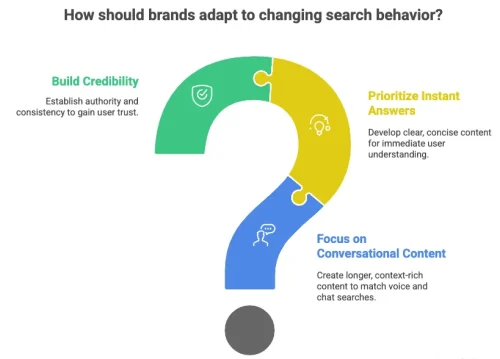 AI-powered search reflects a broader shift in how people seek information.
1. From Keywords to Questions
Users are no longer searching:
“best CRM software”
They’re asking:
“What’s the best CRM for a small business with under 10 staff?”
Voice and chat searches are:
- Longer
- More conversational
- Context-rich
This changes how brands need to structure and present information.
Preparing Your Brand for AI-Powered Search?
Understand how voice, chat, and answer engines are reshaping discovery — and what it means for your content strategy.

2. From Browsing to Instant Answers
Traditional search rewarded websites that attracted clicks.
AI-powered search rewards content that can explain clearly and quickly.
Users increasingly expect:
- Immediate answers
- Simple explanations
- Actionable summaries
If your content can’t be easily understood and summarised, it’s less likely to surface.
3. From Exploration to Trust-Based Discovery
When AI delivers an answer, users often trust it by default.
That means brands aren’t just competing for rankings — they’re competing for credibility.
AI-powered search favours sources that appear:
- Authoritative
- Consistent
- Helpful
- Easy to interpret
Voice Search: Optimising for Spoken Queries
Voice search is one of the earliest forms of AI-powered search, and it continues to grow with mobile and smart devices.
How Voice Search Differs
Voice queries tend to be:
- Question-based
- Location-aware
- Intent-driven
For example:
- “Where’s the best café near me?”
- “How do I reset my router?”
- “What does brand identity mean?”
What This Means for Brands
Content that performs well in voice search typically:
- Answers specific questions
- Uses natural language
- Is structured clearly
- Provides concise explanations
Voice search rewards clarity over complexity.
Chat-Based Search: Discovery Through Conversation
Chat-based search tools allow users to explore topics through dialogue rather than one-off queries.
Instead of searching multiple times, users:
- Ask follow-up questions
- Refine intent mid-conversation
- Expect contextual continuity
This creates a new discovery pattern where:
- Brands are introduced inside explanations
- Concepts are explained step by step
- Authority builds through repeated references
Content that supports this experience is educational, structured, and neutral in tone.
Answer Engines: Search Without Clicking
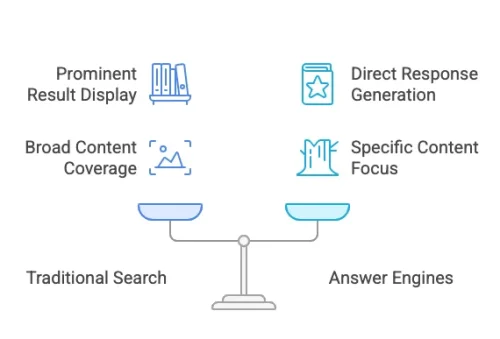
Answer engines generate responses directly, often without showing traditional results prominently.
Examples include:
- Google’s generative summaries
- AI-powered research tools
- Integrated search within AI platforms
These engines prioritise:
- Definitions
- Frameworks
- How-to explanations
- FAQs
- Clear comparisons
For brands, this means visibility now includes being referenced, not just visited.
What AI-Powered Search Looks for in Content
Across voice, chat, and answer engines, similar patterns emerge.
AI-powered systems prefer content that is:
- Clearly structured
- Easy to summarise
- Factually accurate
- Written for understanding
- Focused on user intent
Formats that work well include:
- “What is…” guides
- Step-by-step explanations
- Educational blog posts
- Topic overviews
- Frequently asked questions
Why This Matters for Brands
You don’t need to “optimise for AI” overnight — but you do need to understand the direction search is heading.
Brands that adapt early benefit from:
- Greater discoverability across new search formats
- Stronger authority signals
- Content that stays relevant longer
- Better alignment with future SEO changes
AI-powered search isn’t replacing traditional SEO yet — but it’s reshaping how visibility is earned.
Preparing for the Future of Search
For brands starting their journey, a few principles matter:
- Write content for humans first, but structure it clearly
- Focus on answering real questions your audience asks
- Build depth around key topics, not isolated pages
- Prioritise clarity over cleverness
At Ptech, we often see that brands investing in education-led content today are better positioned as AI-powered search becomes the norm.
Conclusion
AI-powered search is changing how people discover brands — through voice, chat, and answer-driven experiences.
The shift isn’t about chasing new tools. It’s about understanding how users search, how AI interprets content, and how trust is built in an answer-first world.
Brands that focus on clarity, usefulness, and intent will remain visible — no matter how search evolves.
If you’re thinking about how search behaviour is changing and what it means for your content strategy, starting with awareness is the right first step.

Frequently Asked Questions
AI-powered search uses artificial intelligence to deliver direct, conversational answers instead of traditional search results.
Traditional SEO focuses on rankings, while AI-powered search prioritises clear answers, intent, and authority.
Voice search reflects conversational behaviour and high intent, making clear, question-based content more discoverable.
Answer engines generate summaries from multiple sources, often removing the need for users to click websites.
No. It evolves SEO by shifting focus from keywords to clarity, structure, and user intent.