The Complete Guide to Branding Packages and Costs in 2026
A branding package is often one of the first serious investments I see businesses make, and also one of the most misunderstood.
Some teams come in thinking it just means getting a logo done. Others already have a folder full of design files, yet a few months later, their social posts, sales decks, and website visuals still feel disconnected. In most cases, the problem isn’t bad design. It’s that the scope was never clearly defined.
I’ve seen two branding packages look similar on the surface but serve completely different purposes. One delivers a visual symbol. The other gives the business a usable brand system that supports marketing, sales, and growth. That difference matters more than most people realise.
In this guide, I’ll break down what a branding package actually includes, why pricing varies so widely, and how to choose an option that still works long after the design phase ends.
What Is a Branding Package?
A branding package is not a single creative deliverable. It is a structured identity system designed to help a business look, feel, and communicate consistently across every touchpoint.
When branding works well, it removes guesswork. Designers know how to apply the brand. Marketing teams know how campaigns should look. Sales teams use materials that feel aligned. The brand becomes something people can use every day, not just something that looks good on a mood board.
What’s Typically Included in a Branding Package
Most professional branding packages I work with include several connected parts.
Logo system
A logo is rarely just one file. Businesses typically receive primary, secondary, and simplified versions, plus variations for different backgrounds and formats. This avoids distortion, colour misuse, and inconsistency across platforms.
Colour palette and typography
Colours and typefaces often create recognition before people even read the brand name. When these are clearly defined, everything feels like it belongs to the same visual family.
Brand guidelines
These guidelines act as a reference manual. They explain how visual elements should be used and, just as importantly, what should be avoided. Without guidelines, even strong designs drift over time.
Digital brand assets
Templates and visual frameworks for social media, websites, and online materials. These become critical once Digital marketing efforts begin scaling.
Print and stationery assets
Business cards, presentation templates, and document systems. These still play a role in credibility, especially in professional or B2B settings.
Optional strategic components
Some packages go further into positioning, messaging frameworks, and tone of voice. These shape how the brand speaks, not just how it looks.
The way I see it is simple:
- A logo represents a brand.
- A branding package equips a business to use its brand correctly and consistently.
What Drives the Cost of Branding Packages?
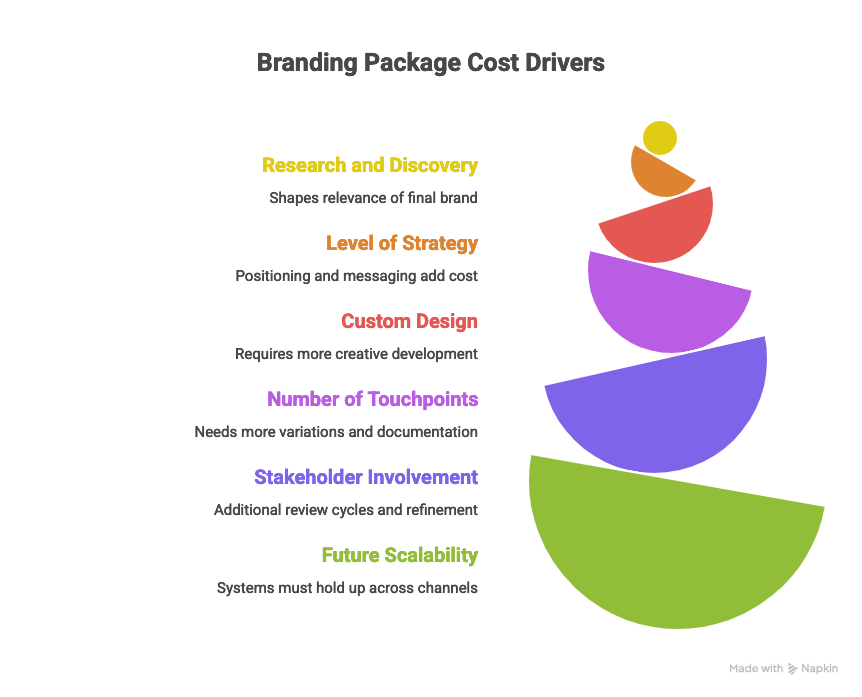
Before talking about price, I think it’s more useful to understand what changes the scope. Branding costs aren’t about decoration. They’re about depth and usability.
Key Cost Drivers
Research and discovery
Time spent understanding the business, market, and audience influences the relevance of the final brand. This work is invisible but shapes everything that follows.
Level of strategy involved
Projects that include positioning and messaging sit at a different level from purely visual design tasks.
Custom design vs templated work
Original identity systems require more creative development than adapting pre-existing structures.
Number of brand touchpoints
A business operating across the web, social media, advertising, and print needs more variations and documentation.
Stakeholder involvement
More decision-makers often mean additional review cycles and refinement.
Future scalability
Brands built for expansion require systems that hold up across new channels and markets.
Understanding these drivers helps businesses evaluate proposals logically rather than focusing only on price.
How Much Do Branding Packages Cost?
There is no single answer because branding scope changes significantly from one project to another.
Typical Branding Package Cost Ranges (2026)
Entry-level / startup branding packages
These focus on foundational identity tools such as a logo system and basic guidelines. Suitable for early-stage businesses that need structure but have limited complexity.
Mid-range branding packages
These often include more robust guidelines, digital-ready assets, and some strategic input. They suit businesses investing in growth channels such as SEO and ongoing marketing.
Strategic / full-service branding packages
These combine research, positioning, messaging, and comprehensive identity systems. They are common for rebrands or businesses entering competitive markets.
How Timeline Impacts Cost
Short timelines compress creative and discovery phases. Phased projects allow deeper exploration but extend duration. The more stakeholders involved, the longer alignment takes. Time affects both process depth and project cost.
Why Branding Packages Matter for Business Growth
Branding is often mistaken for visual polish. In practice, it functions more like infrastructure.
Consistent brands build trust faster. That trust influences conversion rates, sales conversations, and marketing performance. When visual systems are clear, campaigns across SEO, advertising, and social media feel unified rather than pieced together.
Brand systems also improve internal efficiency. Teams spend less time reinventing materials. Designers work within clear parameters. Marketing output becomes faster and more cohesive. Over time, structured branding outperforms one-off design fixes because it supports repeated use, not just initial presentation.
How to Choose the Right Branding Package for Your Business
Choosing the right package starts with the business context.
- A startup may need core identity tools to appear professional.
- A growing business may require clearer positioning and digital-ready systems.
- A rebrand may need strategic alignment before design begins.
Useful questions include:
- Does this package include strategic thinking or only design?
- Will these assets scale across future marketing channels?
- Are guidelines detailed enough for internal teams to follow?
The goal is not to buy more elements, but to invest in a system that matches business stage and growth plans.
Ptech Branding Packages
Ptech branding packages concentrate on creating brands that are functional, scalable, and directly linked to business growth, rather than merely visually attractive.
Clients benefit from:
- Brand foundations that align with their business objectives
- A comprehensive identity system that teams can implement consistently
- Digital-ready brand assets that enhance marketing effectiveness
- Scalable branding that evolves with the business
- Clear guidelines for daily brand application
The outcome is a practical brand system that bolsters marketing, sales, and long-term growth, beyond just a collection of design files. Contact us
FAQs
- How long does a branding package usually take? Timelines depend on scope and discovery depth. Basic identity projects may take weeks, while strategic branding systems can extend over several months.
- Do businesses need a branding package if they already have a logo? Yes. A logo alone does not provide systems or guidelines. Branding packages ensure consistent use across channels.
- Can small businesses afford professional branding packages? Yes. Scope-based options allow businesses to start with essential elements and expand as they grow.