Track Digital Marketing KPIs That Drive Real Growth

Most businesses I speak with aren’t short on data. They’re tracking website traffic, ad performance, engagement metrics, campaign reach, sometimes across half a dozen platforms. Reports are delivered regularly. Dashboards look impressive. Yet despite all these measurements, a familiar frustration emerges:
“We’re tracking everything… so why does growth still feel unpredictable?”
The issue usually isn’t visibility. Its interpretation. Not every metric reflects performance. Not every number deserves strategic attention. And without clearly defined digital marketing KPIs, businesses end up measuring activity instead of outcomes.
In this article, I’ll break down why clarity often disappears inside data-heavy reporting and how choosing the right KPIs changes decision-making, optimisation, and growth itself.
Why Businesses Track Data Yet Still Struggle with Clarity
More data doesn’t automatically produce better decisions. In fact, it often creates the opposite.
Too Many Numbers, Not Enough Meaning
I frequently review dashboards packed with charts, percentages, and comparisons. Traffic trends, engagement rates, click volumes everything is technically measured.
But when I ask what it all means for growth, the answer is often vague.
- Movement is visible.
- Impact is unclear.
Dashboards can describe performance without actually guiding it.
When Activity Is Mistaken for Performance
Traffic increases feel reassuring. Engagement spikes feel encouraging. But neither guarantees commercial progress. A campaign can generate thousands of visitors and still underperform if conversions remain weak. Social engagement can climb while lead quality declines. Without defined KPIs tied to business objectives, activity metrics become dangerously seductive.
The Consequences of Measuring the Wrong Signals
Measurement shapes behaviour.
- Optimise for impressions → chase visibility
- Optimise for clicks → chase traffic
- Optimise for KPIs → chase outcomes
Choosing the wrong indicators doesn’t just distort reports. It distorts strategy.
KPI vs Metric: A Distinction That Changes Decisions
This is where clarity either begins or collapses.
What Is a Metric?
A metric is any measurable data point.
Page views, bounce rate, email opens, ad clicks, and follower growth: these numbers describe behaviour and activity. They provide context and diagnostics. But they don’t define success.
What Makes a KPI Different?
A Key Performance Indicator (KPI) is a metric with strategic priority.
It is deliberately chosen because it reflects progress toward a business objective.
- Leads generated
- Customer acquisition cost
- Revenue from paid channels
- Return on ad spend
KPIs evaluate outcomes. Metrics explain patterns.
Why This Difference Matters in Practice
Metrics help interpret performance. KPIs direct decisions. Without KPIs, reporting is merely descriptive. With KPIs, reporting becomes directional, and direction drives growth.
Core Digital Marketing KPIs That Influence Business Outcomes
Effective KPIs connect marketing investment to commercial reality.
Lead & Demand Generation KPIs
For many SMEs, growth begins here.
- Lead volume indicates demand generation capacity.
- Cost per lead reveals efficiency.
- Conversion rates expose quality and funnel alignment.
Without these, businesses often mistake traffic growth for pipeline growth.
Revenue & Profitability KPIs
Performance marketing lives or dies on financial outcomes.
- Revenue from digital channels
- Return on ad spend (ROAS)
- Revenue per visitor
These indicators clarify whether campaigns scale profitably or simply generate noise.
Acquisition Efficiency KPIs
Customer Acquisition Cost (CAC) sits at the centre of sustainable growth. Revenue without cost discipline creates fragile expansion. CAC provides economic grounding.
Engagement Quality KPIs
Not all engagement signals buying intent. Conversion rates, qualified traffic, and behavioural indicators on high-intent pages distinguish curiosity from commercial interest.
Retention & Customer Value KPIs
Long-term profitability often depends less on acquisition and more on value maximisation.
- Customer Lifetime Value (LTV)
- Repeat purchase rate
- Retention metrics
These determine whether growth compounds are constantly reset.
KPIs by Channel
Different channels require different performance lenses.
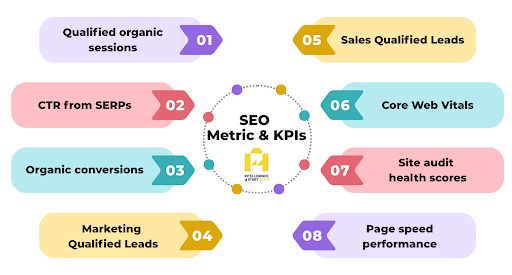
SEO KPIs
- Qualified organic traffic
- Organic conversions
- Keyword visibility
Paid Ads / PPC KPIs
- ROAS
- Cost per acquisition
- Conversion efficiency
Social Media KPIs
- Cost per result
- Engagement-to-conversion ratio
- Lead quality
Email Marketing KPIs
- Revenue per campaign
- Click-to-conversion rate
- Subscriber retention
Content Marketing KPIs
- Assisted conversions
- Engagement depth
- Attribution impact
No single KPI fits every channel. Context defines relevance.
Mapping KPIs to the Marketing Funnel
KPIs gain sharper meaning when aligned with the customer journey.
Awareness Stage
Reach, impressions, and traffic quality help evaluate visibility and relevance. But scale without targeting precision rarely produces downstream performance.
Consideration Stage
Engagement depth, time on site, and lead indicators begin signalling intent and evaluation. This is where interest becomes measurable.
Conversion Stage
Sales, conversion rates, and acquisition costs determine whether marketing investment translates into growth. This stage exposes economic truth.
Retention Stage
Repeat purchases, LTV, and retention metrics reveal sustainability. Because profitable growth rarely ends at conversion.
How I Choose the Right KPIs for Different Businesses
There is no universal KPI framework. Business stage, model, and priorities reshape what truly matters.
Business Stage Shapes KPI Priorities
Early-stage businesses often prioritise visibility, traffic growth, and demand validation. Scaling businesses shift toward efficiency — CAC, conversion optimisation, ROAS. More mature organisations emphasise profitability, retention, and LTV expansion. KPIs evolve as businesses evolve.
Growth Models Demand Different Indicators
Lead generation businesses, ecommerce brands, and subscription services each require different performance lenses.
Applying the wrong KPIs creates distorted optimisation.
Start with Business Objectives, Not Channels
KPIs should reflect outcomes the business genuinely values.
- Revenue
- Qualified leads
- Retention
- Profitability
Not platform vanity metrics.
Prioritise One Dominant KPI per Objective
- Too many priorities dilute decision-making.
- Clarity requires hierarchy.
Review KPIs as Strategy Evolves
- Markets shift. Strategies adapt.
- Measurement must follow.
How Ptech Turns Data into Strategic Clarity
At Ptech, reporting isn’t about presenting more numbers.
It’s about designing KPI frameworks that align digital marketing performance with commercial objectives. We focus on indicators that guide decisions, growth, efficiency, and scalability rather than dashboards that simply describe movement.
Because data only becomes valuable when it drives action.
Explore how we approach Digital marketing strategy and performance optimisation.
Conclusion
Metrics describe activity. Digital marketing KPIs define progress.
When businesses prioritise the right indicators, reporting becomes clearer, optimisation becomes smarter, and growth becomes more predictable.
The objective isn’t tracking more data.
It’s identifying the signals that truly influence business outcomes.
Q1: How many digital marketing KPIs should I track?
Focus on 1-3 core KPIs that directly align with your business objectives. Tracking too many metrics creates confusion and dilutes focus, while too few may not provide a complete picture. Choose KPIs that represent different stages of your marketing funnel and provide actionable insights for optimisation.
Q2: What’s the difference between a KPI and a metric?
A metric is any measurable data point from your marketing efforts, such as page views or email opens. A KPI is a specific metric tied directly to a business goal that indicates success or failure. All KPIs are metrics, but not all metrics qualify as KPIs—only those critical to achieving your objectives.
Q3: How often should I review my digital marketing KPIs?
Review frequency depends on your campaign type and business needs. Monitor real-time KPIs like ad spend daily, tactical KPIs like engagement weekly, and strategic KPIs like ROI monthly or quarterly. Establish a regular review schedule with stakeholders to ensure everyone stays informed and aligned on performance.