How Vietnamese Businesses Can Successfully Enter the Australian Market
 Expanding your business into Australia opens doors to exciting growth opportunities. With its dynamic economy, digital readiness, and strong trade ties with Vietnam, Australia stands out as a promising destination. To succeed, Vietnamese entrepreneurs need a clear go to market marketing strategy that’s grounded in research, localization, and execution excellence.
Understand the Market Landscape
Before launching, analyze the Australian market deeply. Identify your target audience, industry gaps, and consumer demands.
For instance, Vietnamese food products—like coffee, sauces, and ready-to-eat meals—are gaining popularity among health-conscious and multicultural consumers. Understanding these trends ensures your go to market strategy aligns with real opportunities.
Tailor Your Brand Message
Australians value authenticity, sustainability, and transparency. Emphasize your product’s Vietnamese heritage and story—this creates emotional connection.
Tips to Localize Your Brand:
- Highlight ethical sourcing and eco-friendly production.
- Use local slang and tone in marketing copy.
- Showcase customer testimonials or partnerships in Australia.
Leverage Multicultural Marketing in Your Market Entry Strategy
Australia’s multicultural society is an advantage. With a large Vietnamese-Australian community, you can build loyalty through culturally resonant messaging. Data from the Australian Bureau of Statistics (ABS) shows that over 30% of Australians speak a language other than English at home — highlighting the power of inclusive marketing.
Effective Approaches:
- Partner with community influencers or diaspora groups.
- Run bilingual ads (English and Vietnamese).
- Engage in cultural events like Tết Festival or Asia-Pacific Food Expo.
Find Local Partners
Forming alliances with local distributors, marketing agencies, or e-commerce platforms helps overcome regulatory and cultural barriers. Local expertise streamlines entry and strengthens credibility.
Partnership Examples:
- Retail distributors for FMCG or F&B.
- Local PR and digital agencies for market campaigns.
- Business chambers (like Vietnam–Australia Business Council) for networking.
Focus on Digital Marketing
Australians are highly active online. Invest in digital marketing strategies, including social media, SEO, and Google Ads, to increase visibility and drive sales.
Step-by-Step Go to Market Strategy
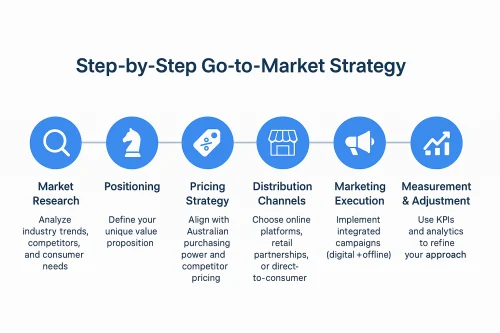
- Market Research: Analyze industry trends, competitors, and consumer needs.
- Positioning: Define your unique value proposition.
- Pricing Strategy: Align with Australian purchasing power and competitor pricing.
- Distribution Channels: Choose online platforms, retail partnerships, or direct-to-consumer.
- Marketing Execution: Implement integrated campaigns (digital + offline).
- Measurement & Adjustment: Use KPIs and analytics to refine your approach.
Challenges to Prepare For
- Regulatory compliance: Food labeling, packaging, and health standards are strict.
- Logistics: Shipping and warehousing costs can impact margins.
- Competition: Local and international brands are already well-established.
- Consumer behavior: Australians value sustainability and transparency.
How Ptech Can Help You
At Ptech, we guide businesses through every stage of their go-to-market strategy in Australia:
- In-depth market research
- Branding and positioning
- Digital marketing execution (SEO, Ads, Social Media)
- Local partnerships and business consulting
Ready to expand your Vietnamese business into Australia? Contact Ptech today for a tailored strategy.
Conclusion
Entering the Australian market in 2025 demands agility, localization, and data-driven strategies. From AI-powered marketing to cross-border e-commerce, success comes from understanding consumer behavior and adapting quickly.
Businesses that invest in solid go-to-market planning, digital execution, and trusted partners like Ptech will thrive in the evolving Asia-Pacific landscape.
Frequently Asked Questions
A go-to-market strategy defines how a business introduces its product or service into a new market, covering research, positioning, pricing, and marketing execution.
It minimizes risks, aligns marketing with audience needs, and ensures resources are used effectively.
With a solid GTM plan, most businesses see measurable traction within 6–12 months.
Food & beverage, e-commerce, beauty, FMCG, and tech-enabled services are strong sectors.
Attend trade fairs, join business chambers, or consult with local experts like Ptech to identify strategic partners.
Begin with market research and a digital readiness audit to validate your product-market fit.