How to Start Digital Marketing for Your Business (Step-by-Step)
I’ve lost count of how many times I’ve heard a business say, “We’ve already started digital marketing.” When I look closer, it usually means they’ve run some ads, opened a few social accounts, or posted a handful of blogs. Activity is there. Money is going out. But results feel inconsistent, unpredictable, or flat.
In most cases, the issue isn’t the channel. It’s how digital marketing was started. Without structure, marketing becomes a series of disconnected actions instead of a growth system. What I want to do here is walk through what “starting digital marketing” should actually mean and why the foundation matters more than the tools.
Why Most Businesses Start Digital Marketing the Wrong Way
Starting with channels instead of strategy
A common pattern appears: a business hears that Google Ads works, or that SEO is important, or that competitors are active on social media. So they start there. No clear objective, no defined audience journey, no measurement framework. Channels are treated as solutions instead of tools.
Activity mistaken for progress
Posts go up. Ads run. Traffic increases. But enquiries stay flat. Revenue doesn’t move. Marketing activity creates the feeling of momentum, yet business growth doesn’t follow. Without defined outcomes, activity becomes noise.
Disconnected marketing efforts
The website says one thing. Ads say another. Social content goes in a different direction. Each part of marketing operates separately, rather than supporting one clear message and goal. Digital marketing works best as a system, not as isolated tasks.
This is where many businesses get stuck: not because digital marketing fails, but because it was never set up to succeed.
What Starting Digital Marketing Should Actually Mean
To me, starting digital marketing isn’t about opening accounts or launching campaigns. It’s about building a system that turns attention into business outcomes.
For a business, digital marketing should function as:
- A structured way to attract the right audience
- A process that converts visitors into leads or customers
- A mechanism that supports the sales process
- A measurable growth engine
Without these pieces, marketing becomes trial and error. With them, it becomes more predictable. The shift is from “trying things” to building a repeatable growth process.
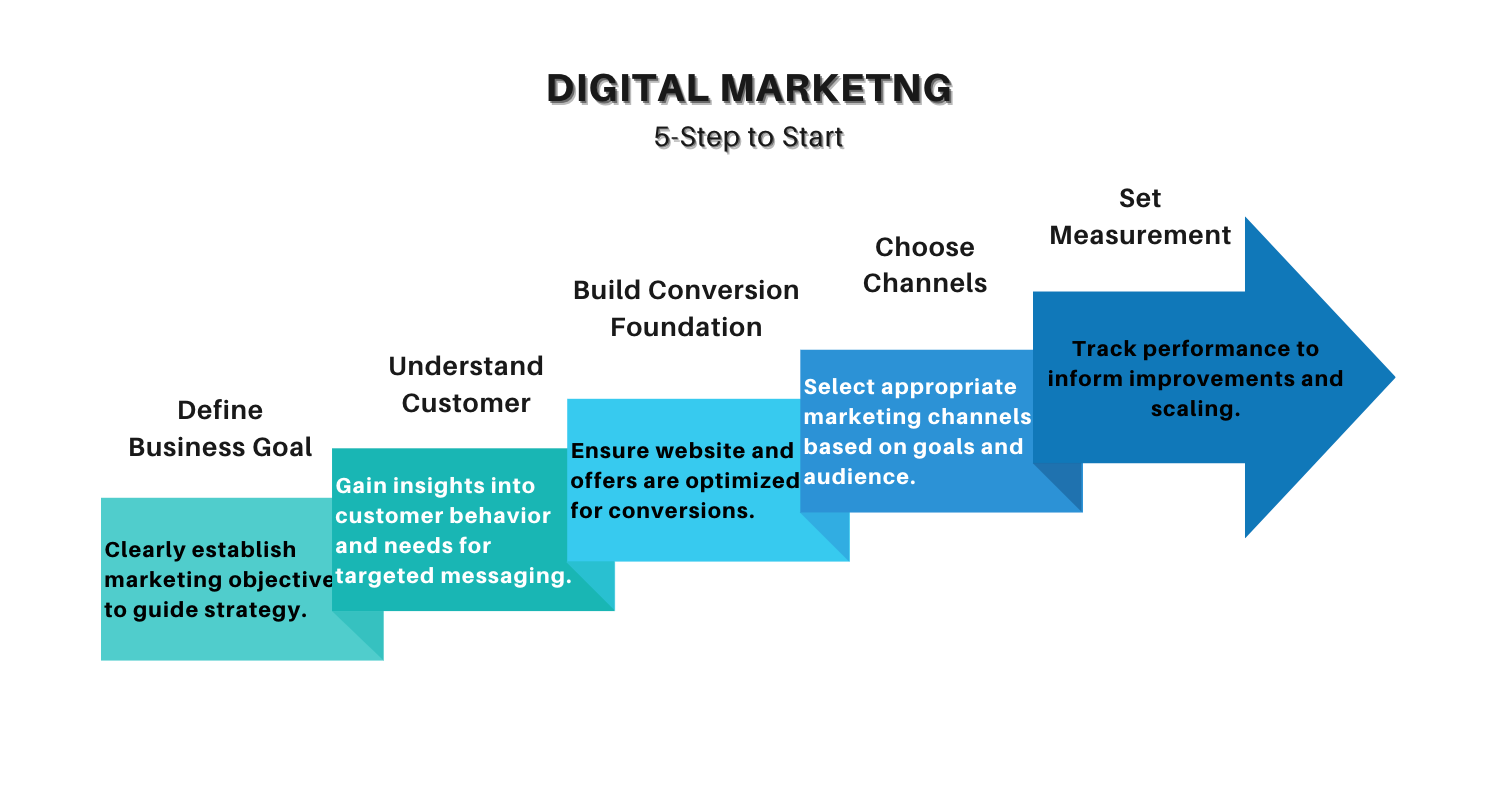
Step 1 – Define Your Business Goal First
Before any campaign runs, I want clarity on what marketing is supposed to achieve.
Is the priority:
- Generating more qualified leads?
- Increasing online sales?
- Building brand authority in a competitive market?
- Entering a new segment?
Digital marketing should solve a business bottleneck, not just increase website traffic. Traffic without purpose rarely produces meaningful results.
When the goal is clear, everything else aligns:
Goal → KPI → Channel choice → Messaging → Measurement.
Without that starting point, marketing decisions become guesswork.
Step 2 – Understand Your Customer Before Marketing to Them
Channels and tactics only work when they match how customers think and behave.
Key questions a business should answer:
- Who actually makes the decision?
- What problem are they trying to solve?
- What do they need to see before they trust a provider?
- How do they typically research solutions?
Messaging depends on this understanding. So does channel selection. Some audiences respond to search. Others rely on social proof. Others to education-first content.
When customer understanding is missing, marketing often speaks to everyone and resonates with no one.
Step 3 – Build the Conversion Foundation
Before I try to bring traffic in, I want to make sure there’s somewhere effective for that traffic to go.
This means:
- Clear positioning on the website
- A well-defined offer
- Strong calls-to-action
- Trust signals (proof, testimonials, credibility)
I often see businesses push for more visitors before their site is ready to convert them. That’s where spend gets wasted. Digital marketing doesn’t really start with traffic volume; it starts with conversion readiness.
Step 4 – Choose Channels Based on Fit, Not Trend
Only after goals, audience, and conversion foundations are clear should channel decisions happen.
Channels are tools. Different tools solve different problems.
| Business Need | Channel Fit |
| Immediate lead flow | Google Ads |
| Long-term demand capture | SEO |
| Brand awareness and engagement | Social media content |
| Retention and nurturing | Email marketing |
Trends change. Channels evolve. But the role of each channel within the system remains consistent. Businesses that choose based on fit build stability. Those who follow trends often restart every year.
Step 5 – Set Measurement from Day One
If performance cannot be measured, marketing cannot improve.
At a minimum, businesses should track:
- Leads or sales generated
- Conversion rate
- Cost per acquisition
- Revenue contribution
Measurement turns marketing from an expense into an investment. It shows what works, what needs improvement, and where to scale. Without tracking, decisions are based on opinion instead of data.
How Ptech Helps Businesses Start Digital Marketing the Right Way
At Ptech, we don’t start with ads or platforms. We start with business clarity. The process focuses on:
- Understanding growth goals
- Building conversion-ready digital foundations
- Selecting the right channel mix
- Setting up tracking and reporting systems
- Aligning marketing activity with business outcomes
This approach ensures digital marketing functions as a structured growth system, not a collection of disconnected tasks.
Conclusion
From where I stand, digital marketing doesn’t really begin with ads, social posts, or SEO tools. It begins with clear goals, clear customer understanding, and a system designed to turn attention into results.
Businesses that start with structure build predictable growth. Those that start with channels often end up with activity but no clear progress.
Build your digital marketing on a strategy. Create a structured system that turns attention into measurable, predictable business growth with Ptech.
FAQs
- Do businesses need a website before starting digital marketing? Yes. Digital marketing drives people somewhere. Without a conversion-ready website, traffic has nowhere effective to turn into enquiries or sales.
- Should small businesses start with ads or SEO? It depends on urgency. Ads can generate faster leads, while SEO builds long-term demand capture. Many businesses use both in different roles.
- How much budget is needed to start digital marketing? Budget matters, but structure matters more. A clear system often outperforms a larger budget spent without direction.