Why Businesses Outsource Web Development Today
I’ve seen this play out many times. A business decides to build its own website. At first, it feels manageable. A few pages, some design tweaks, maybe a plugin or two. Then reality sets in, and deadlines slip. Small technical issues take hours to fix. One update breaks something else. What started as a quick internal project slowly turns into a long-running distraction.
To me, a website is never just a digital presence. It shapes how potential customers judge the business, how marketing campaigns perform, and whether traffic turns into enquiries or sales. That’s why I think it’s important to understand when outsourcing web development makes sense, what the process actually involves, and how to avoid decisions that look affordable early but become expensive later.
When Should a Business Outsource Web Development?
Outsourcing is rarely the first instinct. Most businesses try to handle web development internally until friction becomes impossible to ignore.
The internal team is stuck or overloaded
In many SMEs, web tasks fall onto whoever is closest to tech. That person already has other responsibilities. Over time, the website becomes a list of unresolved items: bugs, speed issues, integration problems, and small design fixes that never quite get done. The site does not evolve, and it just survives.
Website affects revenue, not just appearance
A basic informational site can tolerate simple development. But once the website becomes a lead engine, sales channel, or marketing hub, the stakes change. Conversion tracking, SEO structure, performance speed, and integrations with CRM or email systems become essential. At that point, technical decisions directly influence revenue.
You need speed without hiring full-time
Hiring developers takes time and long-term salary commitment. When a business needs to launch a new product, campaign, or market entry, outsourcing gives access to experienced teams immediately.
What Does Outsourcing Web Development Actually Include?
A lot of businesses think outsourcing just means someone builds the site. From my perspective, that’s only the visible part. Good outsourcing is closer to building digital infrastructure than just producing pages.
A capable partner doesn’t start with colours or layouts. They start with how the website will behave under traffic, how content will be managed later, and how marketing tools connect behind the scenes.
Typical Scope of Outsourced Web Development
Website architecture & technical planning
This is where long-term success is decided. Decisions about structure affect SEO performance, speed, and how easy future changes will be. Poor architecture locks businesses into expensive rebuilds later.
UX/UI design based on user behaviour
Design is not decoration. It shapes how visitors move, where they hesitate, and whether they take action. A good team designs for clarity, not just aesthetics.
Front-end & back-end development
This is the engineering layer: performance, logic, and stability. Clean code means fewer issues when new features or integrations are added.
CMS or e-commerce setup
The website must be manageable. Teams inside the business should be able to update content without breaking things.
Integrations
CRM, email tools, analytics, and payments. These systems connect the website to operations and marketing. Without integration, the site sits isolated from the business.
Performance, security, scalability
Fast load times reduce drop-offs. Security protects trust. Scalability ensures the site still works when traffic grows.
- See how this looks in practice in the Vinh Duong & Associate Law Firm case study, where performance and SEO-readiness were treated as part of the build, not an afterthought.
Testing & launch
Cross-device testing avoids embarrassing failures that damage credibility at first impression.
In short, outsourcing should result in a system that works quietly in the background, not a site that constantly needs fixing.
The Biggest Risks of Outsourcing the Wrong Way
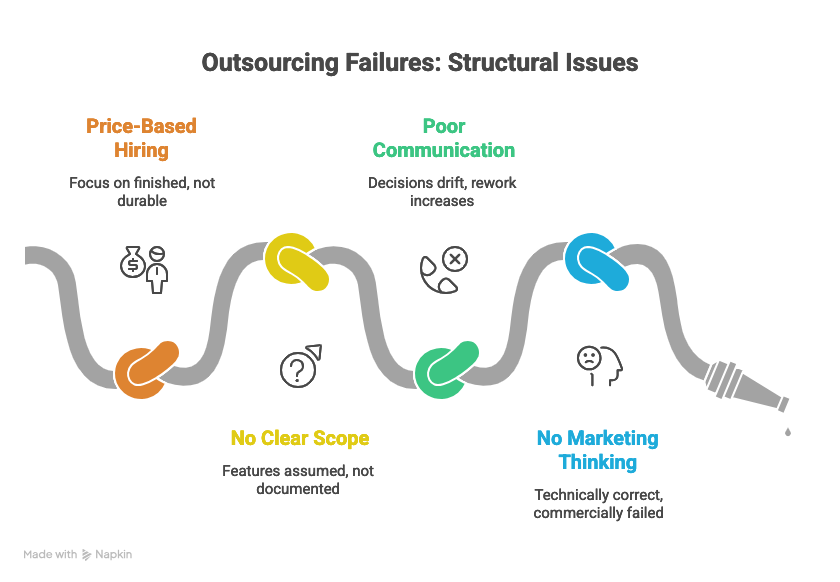
Outsourcing can save months or create months of recovery work. The difference is rarely technical. It is structural.
Hiring based on price, not capability
Lower-cost vendors often focus on delivering a finished site, not a durable one. Code shortcuts may not show immediately, but they appear when the business tries to scale. Adding features becomes complex. Speed declines. SEO performance suffers.
No clear project scope
Scope gaps are where projects derail. When features are assumed but not documented, each change becomes a negotiation. Delays pile up, and both sides feel the project will never be finished.
Poor communication and ownership
Without a clear project lead, decisions drift. Designers, developers, and business stakeholders move in different directions. Rework increases. Frustration builds.
Website built without marketing thinking
A technically correct site can still fail commercially. Without conversion tracking, SEO structure, or lead pathways, the website cannot support growth. It looks professional, but contributes little.
Most outsourcing failures happen not because teams lack skill, but because projects lack alignment.
How to Outsource Web Development the Right Way
Successful outsourcing starts before any vendor is chosen. I treat it as a strategic process, not a transaction.
Step 1: Define the business goal of the website
A website meant to generate leads is built differently from one focused on brand authority or e-commerce. A clear purpose guides every decision afterwards.
Step 2: Write a clear scope before contacting vendors
This forces internal clarity. Features, integrations, timeline, and budget expectations should be outlined. Vendors can then propose solutions rather than guess requirements.
Step 3: Evaluate capability, not just portfolio
Visual design shows style, not process. Ask how projects are managed, how performance is tested, and how post-launch optimisation is handled.
Step 4: Clarify workflow and communication
Predictability reduces stress. Businesses should know how often updates occur, how feedback is collected, and who is accountable.
Step 5: Plan for post-launch, not just launch
Websites evolve with marketing, products, and customer expectations. Ongoing optimisation and support should be considered from the start.
Outsourcing works best when treated as a partnership built on shared objectives, not a one-time purchase.
Outsource vs Build In-House: Which One Fits You?
| Criteria | Outsourcing Web Development | Building In-House |
| Speed of execution | Faster, with an experienced team and established workflows | Slower due to hiring, onboarding, and setup |
| Overall cost structure | Flexible, project-based investment | Fixed long-term costs (salaries, tools, benefits) |
| Level of expertise | Access to diverse skills (UX, development, SEO, tracking) | Dependent on the strengths of a small internal team |
| Scalability | Easy to scale resources up or down as needs change | Scaling requires additional hiring |
| Control & dependency | Requires clear processes to avoid vendor dependency | Knowledge and control stay within the company |
| Best suited for | Businesses needing speed, flexibility, and multi-skilled execution | Companies with a strong tech team and continuous development needs |
Why Choose Ptech for Web Development Outsourcing?
At Ptech, we approach web development as a business growth project, not just a design task. We start by clarifying what the website needs to do generate enquiries, support e-commerce, improve conversions, or build credibility and then build around that goal.
What Ptech provides:
- A clear plan before building (site structure, priorities, and success metrics)
- A managed build process (UX, development, testing, launch, so projects don’t drift)
- Marketing-ready foundations (SEO structure, conversion flow, tracking setup)
- Scalable, maintainable delivery (so the site can grow without rebuilding from scratch)
- Post-launch support (fixes, improvements, and optimisation based on real usage)
The aim isn’t just to hand over a website. It’s to deliver a site that’s built to perform and stays useful as the business evolves.
Conclusion
For me, outsourcing web development isn’t about offloading work. It’s about bringing in the right expertise at the right time so the website can support real business growth.
When goals are clear, scope is managed properly, and capable partners are chosen, outsourcing becomes a way to move faster and avoid technical setbacks. A website should function as a growth asset, not something that quietly consumes internal resources.
Let’s build a website that drives real results, supports growth, and works as a reliable business asset, not a constant distraction.
FAQs
- How long does outsourced web development take? Timelines depend on scope and integrations. Simple sites may take weeks, while complex systems require several months, especially when testing and integrations are involved.
- Is outsourcing cheaper than hiring a developer? Often, yes. Outsourcing avoids recruitment costs and long-term salaries while giving access to broader expertise.
- Can outsourced developers support SEO and marketing? Yes, when technical SEO, tracking, and performance structure are built into the project from the start.