Short-Form Video vs Live Streaming: Where Should Your Media Budget Go?
Marketing teams are investing more into video than ever. But when budgets are finite, one question keeps coming up:
Should you prioritise short-form video or live streaming?
Both formats are powerful. Both can drive results. Yet they play very different roles in the marketing funnel—and choosing the wrong one can lead to wasted spend, mismatched KPIs, and underwhelming ROI.
Short-Form Video vs Live Streaming: Budget Comparison
| Factor | Short-Form Video | Live Streaming |
| Primary role | Reach & awareness | Trust & conversion |
| Production cost | Low–medium | Medium–high |
| Content lifespan | Short, fast turnover | Long, repurposable |
| Engagement depth | Low–medium | High |
| Conversion impact | Indirect | Direct |
| Paid media scalability | Very high | Limited |
| Best use case | Demand generation | Education & decision support |
This table reflects how each format performs when budget efficiency and business outcomes matter.
Now, let’s unpack what this actually means for your media planning.
Before diving into tactics, let’s start with a clear, side-by-side comparison.
Not sure where your video budget should go?
Short-form video and live streaming play different roles.
A strategic review can help you invest where impact matters most.

Why This Comparison Matters for Media Budget Decisions
The mistake many brands make is treating short-form video and live streaming as competing trends.
They’re not.
They are complementary formats designed to support different decision stages.
- Short-form video is optimised for scale and discovery
- Live streaming is optimised for depth and trust
Your budget shouldn’t be split evenly—it should be aligned to intent.
Short-Form Video: Efficient Spend for Scale
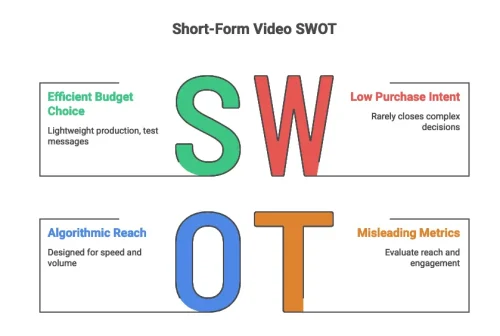
Short-form video (TikTok, Reels, Shorts) is designed for speed, volume, and algorithmic reach.
When Short-Form Video Is a Smart Budget Choice
Short-form video works best when your objective is to:
- Increase brand visibility quickly
- Feed retargeting audiences
- Test creative angles at low cost
- Drive top-of-funnel engagement
Because production is lightweight, brands can test more messages, formats, and hooks—making it highly efficient for paid amplification.
The Limitation to Be Aware Of
While engagement can be high, purchase intent is usually low.
Short-form video:
- Sparks interest
- Introduces a brand
- Creates familiarity
…but rarely closes complex decisions on its own.
That’s why short-form video should be evaluated on:
- Reach
- Engagement rate
- Cost per engaged view
—not immediate conversions.
Live Streaming: Higher Cost, Higher Intent
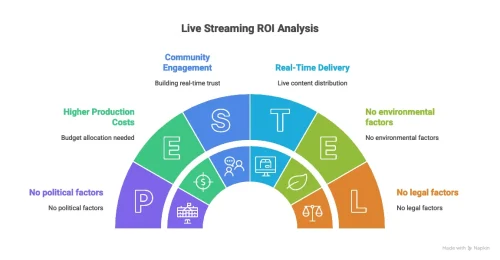
Live streaming demands more planning, production, and on-camera confidence.
But when used correctly, it delivers something short-form can’t: real-time trust.
When Live Streaming Is Worth the Budget
Live streaming performs best when your goal is to:
- Educate prospects
- Address objections
- Demonstrate expertise
- Support purchase decisions
Because viewers opt in and stay longer, live content attracts higher-intent audiences.
It’s especially effective for:
- B2B services
- High-consideration products
- Community-driven brands
How to Measure ROI Correctly
Judging live streams by view count alone is misleading.
Better success indicators include:
- Watch time
- Comments and questions
- Post-event conversions
- Sales influenced, not just attributed
Live content often converts after the stream ends, not during it.
How Agencies Should Split Budget Across Both Formats
Instead of choosing one format, high-performing teams design a role-based allocation.
A common and effective framework:
- 60–70% short-form video for reach, testing, and audience building
- 30–40% live or long-form content for trust and conversion
Short-form fills the funnel.
Live streaming moves people through it.
At Ptech, we often map video spend directly to funnel stages—ensuring each format supports a measurable outcome rather than chasing views alone.
Common Budget Allocation Mistakes to Avoid
Before finalising your split, watch out for these pitfalls:
- Expecting short-form video to drive high-consideration sales
- Underfunding live content because it “doesn’t scale”
- Measuring both formats using the same KPIs
- Producing content without a clear next-step journey
The strongest strategies connect formats, not isolate them.
Conclusion
Short-form video and live streaming serve different strategic purposes.
If your budget is focused on:
- Growth and visibility → short-form video should lead
- Trust and conversion → live streaming deserves investment
The most effective media strategies don’t ask which format is better—
they ask where each format creates the most impact.
If you’re reassessing video spend and want clarity on where budget actually drives results, a strategic review can often unlock quick efficiency gains.
Ready to align video spend with real outcomes?
At Ptech, we help brands connect media formats to funnel intent—so every dollar works harder, not louder.
Frequently Asked Questions
It depends on your goal. Short-form video drives reach, while live streaming builds trust and conversions.
Yes. Short-form video is cheaper to produce and scales easily through paid media.
Live streaming works best for education, product launches, and high-consideration decisions.
Yes. Short-form attracts attention, while live streaming converts engaged audiences.
Most brands allocate more to short-form video and reserve live streaming for conversion-focused moments.