What Is Generative Engine Optimization (GEO) and Why It Matters for 2025 SEO
Search is evolving faster than ever — and in 2025, generative AI is reshaping how people discover information. Instead of showing a list of clickable links, today’s search engines generate answers directly using AI models.
This shift has introduced a new discipline that every brand needs to understand:
Generative Engine Optimization (GEO) — optimizing your content so AI search tools use, cite, and reference your brand inside generated answers.
If SEO helps you appear in search results, GEO helps you become part of the answer itself.
What Is Generative Engine Optimization (GEO)?
Generative Engine Optimization (GEO) is the process of optimizing content for AI-driven search systems such as:
- Google Search Generative Experience (SGE)
- Bing Copilot
- Perplexity
- ChatGPT Search
- Meta AI Search
These tools pull information from trusted sources, summarize it, and present it as a single AI-generated explanation.
GEO ensures:
- AI can understand your content
- AI selects your brand as a credible source
- Your insights appear inside AI answers
- You remain visible even when users no longer click websites
In simple terms:
GEO is SEO adapted for the AI-first search era.
Why GEO Matters in 2025
Preparing your brand for AI-first search?
Ptech helps businesses adapt SEO strategies for generative search engines — from content structure to authority building.

1. AI Answers Are Replacing Traditional Rankings
AI-generated summaries now sit above organic search results.
Even if your site ranks #1, AI may skip your content entirely unless it is GEO-optimized.
Being included inside AI answers is now just as important as ranking on page one.
2. Users Trust AI More Than Search Links
Consumers increasingly ask AI tools:
- “What’s the best CRM for small businesses?”
- “Explain brand identity with examples.”
- “Which café in Melbourne is great for remote work?”
AI responds with clear summaries — often without requiring a click.
If your content is not in the AI’s dataset, your brand won’t appear at all.
3. GEO Strengthens Authority and Brand Credibility
Generative engines prioritize:
- Clear explanations
- Expert-led content
- Structured information
- Factual accuracy
- Topic authority
This forces brands to publish smarter, higher-quality content — which strengthens long-term trust and visibility.
4. Early GEO Adopters Will Outrank Competitors
GEO today is what SEO was in the early 2000s:
new, underused, and full of opportunity.
Businesses that optimize early will dominate AI-driven search and become the “default” recommended brands inside generated answers.
How AI Search Engines Choose What to Display
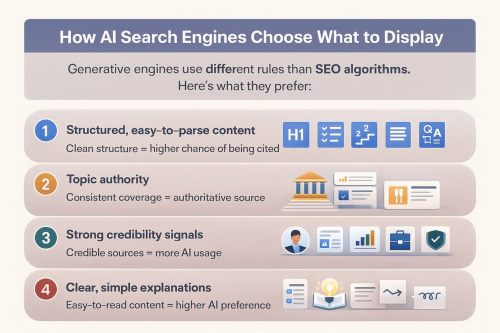
Generative engines use different rules than SEO algorithms.
Here’s what they prefer:
1. Structured, easy-to-parse content
AI models understand:
- Headings
- Lists
- Steps
- Definitions
- Short paragraphs
- FAQs
Clean structure = higher chance of being cited.
2. Topic authority
AI checks whether your site consistently covers the topic.
For example: A brand publishing dozens of articles on restaurant marketing becomes an authoritative source for AI answers related to hospitality and digital marketing.
3. Strong credibility signals
AI prioritizes sources that show:
- Author expertise
- Accurate citations
- First-party data
- Case studies
- Real business examples
- Trustworthy brand history
The more credible your brand looks, the more AI will use your content.
4. Clear, simple explanations
Generative engines avoid vague or overly complex writing.
They favour content that is:
- Direct
- Educational
- Easy to summarize
If a model can’t understand your writing, it won’t use it.
How GEO Differs From Traditional SEO
| SEO (Traditional) | GEO (2025) |
| Ranks pages on SERPs | Places your brand inside AI answers |
| Keyword-focused | Intent + structure-focused |
| Emphasizes backlinks | Emphasizes authority + clarity |
| Goal: increase clicks | Goal: increase citations |
| Optimizes for Google algorithm | Optimizes for AI models |
GEO doesn’t replace SEO — it evolves from it.
What GEO-Optimized Content Looks Like
Examples of formats AI prefers:
- “What is…” guides (TOFU educational content)
- How-to articles with steps
- Frameworks, models, and methods
- Industry definitions
- FAQs
- Data-backed content
- Expert commentary
If your content is easy for humans and AI to interpret, you’re on the right track.
2025 GEO Checklist: How to Prepare Your Brand
Here are practical steps any business can start today:
1. Structure your content clearly
Use headings, bullets, and short sections.
2. Build topic clusters
Choose your niche and create multiple articles around it.
3. Strengthen E-E-A-T
Include bios, credentials, real results, and data.
4. Publish “definition + explanation” content
AI often pulls these into the answer box.
5. Update your content regularly
Fresh, accurate content ranks better with generative engines.
6. Avoid fluff
Be factual, concise, and specific.
Conclusion
Generative Engine Optimization (GEO) marks a new era for search. As AI-generated answers take over traditional results, businesses must pivot from “ranking high” to being included in AI summaries.
Brands that embrace GEO early will:
- Maintain strong search visibility
- Build deeper authority
- Win organic traffic in an AI-first world
- Outperform competitors still relying on old SEO methods
This shift has already begun — and GEO is quickly becoming essential for any business that wants sustainable digital visibility in 2025 and beyond.

Frequently Asked Questions
GEO is the practice of optimizing content so generative AI tools like Google SGE and ChatGPT Search can use and cite your information.
SEO ranks pages on search engines; GEO ensures your content appears inside AI-generated answers.
AI summaries are reducing organic clicks. If your content isn’t GEO-optimized, you may lose significant visibility.
Definitions, step-by-step guides, structured lists, FAQs, expert insights, and data-backed content.
No — GEO builds on SEO. Both are needed to stay visible in AI-driven search.